Groupshow
Re/Enactments
Project Info
- Location: Coulisse Gallery Stockholm
- Artist: Groupshow
- Text: Michaela Yarmol-Matusiak
- Photographer: Julia Malmquist
Share on

Installation view, Re/Enactments. Photo: Julia Malmquist
Advertisement


Reeha Lim, untitled, 2026, acrylic on silk, hand carved artist frame, Korean pagoda dogwood. Photo: Julia Malmquist

Mikołaj Sobczak, Sylvin Rubinstein, 2024, oil, print on wood, disassembled metal stand. Photo: Julia Malmquist

Detail, Mikołaj Sobczak, Sylvin Rubinstein, 2024, oil, print on wood, disassembled metal stand. Photo: Julia Malmquist

Detail, Mikołaj Sobczak, Sylvin Rubinstein, 2024, oil, print on wood, disassembled metal stand. Photo: Julia Malmquist

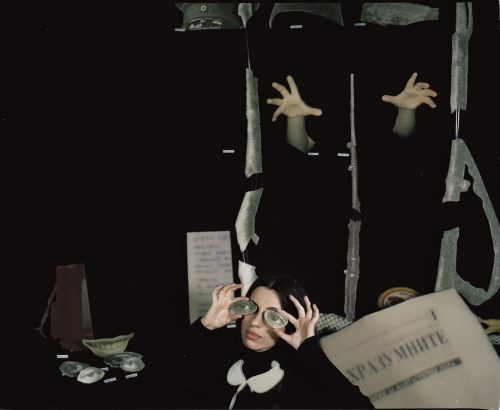
Alex Margo Arden, Sleeping Beauty (I) & Sleeping Beauty (II), 2026 C-type hand print. Photo: Julia Malmquist

Installation view, Re/Enactments. Photo: Julia Malmquist

Installation view, Re/Enactments. Photo: Julia Malmquist

Reeha Lim, untitled, 2026, acrylic on silk, hand carved artist frame, Korean pagoda dogwood. Photo: Julia Malmquist

Detail, Reeha Lim, untitled, 2026, acrylic on silk, hand carved artist frame, Korean pagoda dogwood. Photo: Julia Malmquist

Installation view, Re/Enactments. Photo: Julia Malmquist

Nina Kintsurashvili, Reborn (After Forough), 2025, oil and gesso on unprimed canvas. Photo: Julia Malmquist

Heejae Lim, Study for a Diorama of Mountain Goats, 2026, oil on canvas. Photo: Julia Malmquist

Installation view, Re/Enactments. Photo: Julia Malmquist

Ant Łakomsk, Hardcore, 2026, oil on canvas. Photo: Julia Malmquist

Installation view, Re/Enactments. Photo: Julia Malmquist

Travis MacDonald, Hounds , 2026, oil on canvas. Photo: Julia Malmquist

Travis MacDonald, A predictable kind of freedom, 2026, oil on canvas. Photo: Julia Malmquist

Nana Wolke, 00:00:00,000 --> 00:10:57,967 (A dish best served cold), 2026, construction sand and oil on linen. Photo: Julia Malmquist

Detail, Mikołaj Sobczak, Male Fantasies, 2026, oil and collage on wooden panel. Photo: Julia Malmquist
The group exhibition Re/Enactments highlights ten practices that harness the visual as a site of transmission. Beginning with a slow, continuous, and at times, digestive relation to the image, the presented artists utilise processes of collaging, restaging, and repetition to explore how the visual constructs new sightlines on current and historical social and political realities and beliefs. Working within subjects such as microhistories, cultural mythologies, identity construction, post-colonial society, and queer life, each piece is interested in how these renewed pictorial and spatial approaches may proliferate, entering and travelling through vast loci and contexts. Re/Enactments is then a consideration of new acts of transfer: the exhibition is a proposition towards fuzzy, fragmented, and figurative enactments that drift and shift in a radical multiplication.
Nina Kintsurashvili’s practice examines how mediation, fragmentation, and incomplete access to images shape alternate relationships to the visual within a center–periphery context. Rooted in the Georgian experience during and directly after the collapse of the Soviet Union, where encounters with global visual culture often arrived through reproductions, scans, and photocopies, her work considers what it means to encounter culture indirectly rather than through direct access. Drawing from personal archives spanning archaeology, art history, Byzantine imagery, and children’s illustrations assembled through ongoing engagement with Tbilisi’s Bukinist networks of second-hand book dealers, Kintsurashvili works through accumulation, perceptual translation, and fragmentation [I]. Reborn (After Forough), the title a nod to the work of Iranian poet Forough Farrokhzad, takes its naissance from an issue of a Soviet Georgian children’s journal from 1982. Using abstraction as a gateway to hidden structures, forms retain traces of original references within the final piece while at the same time evading concrete categorisation.
With a similar focus on remaking, Heejae Lim approaches the possibility of representing nature. Studying dioramas of taxidermized animals within natural history museums, Lim spends ample time observing tableaus, dioramas that render the natural world static. Taking pictures of what sits within the frame and vitrine, Lim repeatedly paints these dioramas through these layers of mediation, her own gaze the lasting filter. With each additional study, movement, and light shift, the animal’s forms within the frames are distorted by the multiple translations. Lim’s practice thus utilises the abundance of painting to return an organic pulse lost in the still, fictional dioramas which sit within the gap between depiction and reality.
Staying with what is behind the glass, Alex Margo Arden works with tableau to interrogate the restaging and production of history. Arden’s ethereal coral and forest green Sleeping Beauty prints muse on the figure through its prolific representation in wax mannequins: a classical depiction within the genre [II]. Wax mannequins, like the one in the works, were historically cast from people and preserve an anonymised subject within an unmoving object. Materially, the prints are produced from negatives, which hold little photographic information. The quality of the image echoes the significance of the figures: in tracing the representation of the fairytale, the ghost of the subject persists, all the while its staging holds no desire to trace back to a factual story of a person or history. These apparitions come to life in Sleeping Beauty [II]: a hand rests on the case, and a doubling is produced, the phantom second palm rising to meet the other. At each moment within the prints, Arden then questions authenticity and reality, asking how reenactments attend to embodiment and truth.
Considering the nature of perception, Nana Wolke’s pieces begin with staging live scenarios in environments marked by social, architectural, and psychological restrictions. Shooting footage with consumer cameras and lighting equipment on film-like sets, Wolke transforms the footage into paintings. Blending construction sand with oil on linen, she emphasises the granularity and momentary, lo-fi nature of the films.’ 00:00:00,000 - -> 00:10:57,967 (A dish best served cold) captures a still taken during a research trip to Stockholm in December 2024, investigating the lineage of the Million Programme. Growing up in a social housing neighbourhood on the outskirts of Ljubljana, a 1:1 replica of the city-within-a-city model built in 1960s Sweden, Wolke is interested in contemplating personal experiences to ask how architecture directs the experience of space. The footage of the staircase, men lingering on a winter evening, emerged as a piercing scene of familiarity for Wolke, linking to the instigating inquiry within her practice, examining how moments reveal themselves in an image.
Echoing shared scenographic intentions, Travis MacDonald’s visual worlds depict the inherent fragmentation of social spaces within city environments. The daily scenes within Dogs and Jeans give pause to quotidian moments – a gathering next to a broken fence in a flower-laden field and treading a well-trodden path. With muted pigments and unnamed subjects, each piece illustrates a corner of a landscape, where the viewer may insert their individual rhythms towards MacDonald’s hazy figurations.
Ant Łakomsk draws on a similar indistinct inclination, constructing muffled worlds through which whispers, emotions, and forms murmur. Often painting from digital references directly from phone and computer screens, Łakomsk probes how the analogue space of the canvas can be used to narrate distinct assemblages. In Hardcore’s shadowy environment, Łakomsk merges the haunting figure with the body of the towering rhino. Here, her juxtaposition of mundanity and the absurd crafts the sensation of parallel worlds colliding, foreshadowing an ambiguous and dim fate.
Investigating the lived nature of displacement, Reeha Lim focuses on the visual as a site of translation. Lim’s process continuously integrates translation: influenced by the Korean painting technique baechae, which involves working on both sides of the silk, the pigments embed themselves in the material, conversing through the textile. Lim’s presented series centres on the face as the fragile, semiotic transmitter of emotions. Drawing on childhood memories, each face replicates an expression from Lim’s mother. The expressions that the artist struggled to decode persisted as she moved across cultural contexts. Within each painting, small unpainted windows grant access to embedded images of homes and pearls positioned below the surface. The face is then a threshold, a gate one passes through to encounter the internal.
Homing in on the power of the sonic in disrupting the linearity of pasts, presents, and futures, Rafał Zajko’s Arrhythmia is part of the ongoing body of work ‘Song to the Siren,’ examining the role of the siren in contemporary culture through ceramics, sculpture, installation, and pickling. Within Arrhythmia’s circular salmon-pink bounds, ceramic elements – pipes, nodules, and discs – become futuristic adornments, coded notes on a cyclical score. This iteration centres on the throat as the anatomical site of speech and vocalisation, the part of the body responsible for telling and speculating – urgent strategies Zajko engages with, centring their potential to shape new imaginings.
Crafting the visual space of said alternate imaginings, Mikołaj Sobczak utilises collage to construct narratives with the lives of historic queer figures. Male Fantasies explores the tension between what Freud conceptualises as the pleasure principle and the death drive [III]. Composed of found materials recovered from sidewalks, including pages from a 1990s erotic massage manual, the discarded remnants carry the traces of psychic suppression. Adorning the collage is a painted self-portrait of Sobczak, in which the figure of Death offers him a PrEP pill, pre-exposure prophylaxis, to prevent HIV infection. On the other hand, Sylvin Rubinstein is an homage to the successful flamenco dancer who resisted Nazism during the Second World War, frequently performing and engaging in sabotage activities dressed as a woman, in commemoration of his murdered twin sister and duo partner. The verso of the piece accompanies the recto’s tales of resistance, Sobczak referencing Jan Luyken's 1685 Martyrs Mirror, re-etching the contours of Maria van Beckum and Ursula van Beckum, burned at the stake. Through both works, Sobczak emboldens his narrations with personal perspectives, foregrounding more inhabitable, bolder horizons.
Working with the ideology of collage, Gray Wielebinski’s materially expansive practice employs universal symbols to destabilise normative systems. In an ongoing critique of American hegemonic structures, Wielebinski reorders said symbols to make the seams and tears within macro and micro formations legible. Sitting on the threshold of public and private, the Holster series considers the instability of identity markers used to indicate ownership and materially delineate the self. The cattle tags, reminiscent of hotel keys, denoting one’s property, are hung on empty flagpole holders, their original functions disregarded; nevertheless, they stand at attention, swaying in anticipation of performance. Rearranging a slogan t-shirt, an empty first aid box, and a reversed dart board, Deface This Flag, Pal emphasises a core paradox inherent to myth-making. The title, and similar slogans such as ‘Don’t Tread on Me,’ advocate the maintenance of violence and anger for self-preservation, a maintenance that only begets more isolation and force. Taken together, Wielebinski harnesses the visual to uncover the impulses of power towards their uprooting.
[I] Diana Taylor, The Archive and the Repertoire: Performing Cultural Memory in the Americas (Duke University Press, 2003).
[II] The Sleeping Beauty figure holds the title of the oldest waxwork within Madame Tussauds.
[III] The title of the work references the theorist Klaus Theweleit’s psychoanalytical texts on the fantasies of prominent fascist men.
Michaela Yarmol-Matusiak