Rosario Aninat & Simon Shim Sutcliffe
Come Hell or High Water

'Come Hell or High Water' - Installation view
Advertisement


'Come Hell or High Water' - Installation view

'Ferryman' - Two channel video on displays 5'08, 160 x 15 x 65 cm, 2022

'Guarantees 1' - Plaster cast and wax, 130 x 60 x 30 cm, 2022

'Guarantees 2' - Plaster cast and wax, 240 x 30 x 30 cm, 2022

'Guarantees 2' - Plaster cast and wax, 240 x 30 x 30 cm, 2022

'Hammerhead' - In collaboration with Pedram Sazesh, Concrete and MDF board, 240 x 30 x 4 cm, 2022

'Hammerheard' - detail, 240 x 30 x 4 cm, 2022

'Come Hell or High Water' - Evening installation view

'Ferryman' - Two channel video on displays 5'08, 160 x 15 x 65 cm, 2022

'Guarantees 1' - Plaster cast and wax, 130 x 60 x 30 cm, 2022

'Come Hell or High Water' - Evening installation view
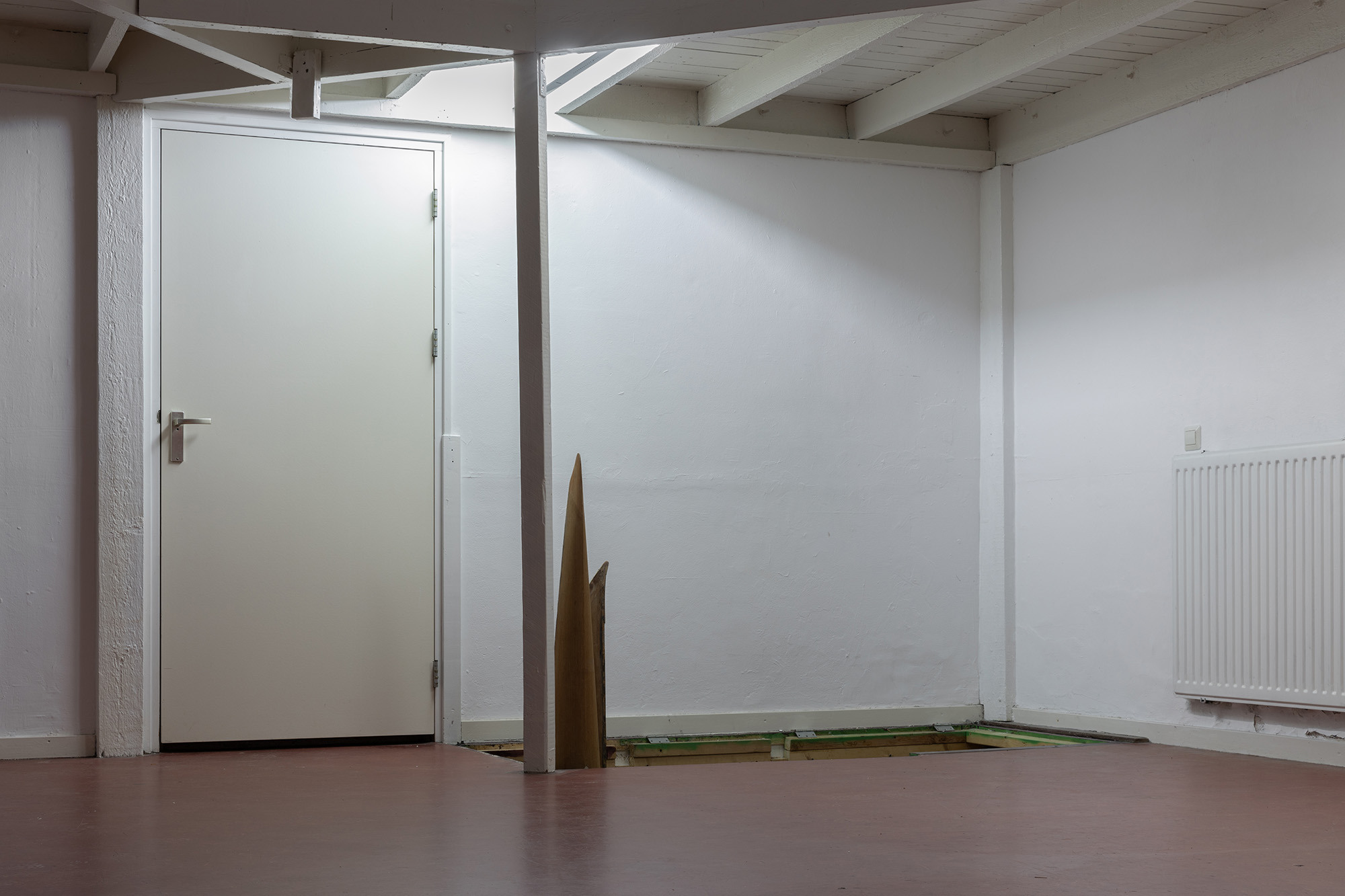
'Come Hell or High Water' - Evening installation view

'Trajectories' - Single person rowing boat, 260 x 30 x 80 cm, 2022

'Trajectories' - Single person rowing boat, 260 x 30 x 80 cm, 2022

'Guarantees 2' - Plaster cast and wax, 240 x 30 x 30 cm, 2022

'Hammerhead' - In collaboration with Pedram Sazesh, Concrete and MDF board, 240 x 30 x 4 cm, 2022

'Come Hell or High Water' - Evening installation view

'Come Hell or High Water' - Evening installation view

'Come Hell or High Water' - Evening exterior view
“When you turn on the faucet and water does not flow, the entire water system
leaps into the cognitive field.”1
For decades Google has been training bots to “see.” Within an image, ai
is being tested to classify “tree,” “stop sign”, “car”, “dog”, “child”, largely to
decide what is the best option for a self driving car to hit in an inevitable
accident. The response to these programmed disasters is arrived at through
the infinity calculated in its simulations, realized in an inhuman speed. The
social relations produced by our technologies of motion and production,
our infrastructures, are in turn producing further technologies. Computed
realism becomes an impulse as a million possibilities are deducted to one in
a fraction of a second. A similar compression in me says “jump” the instant
that I know I cannot; sees the whole nation underwater (again) while driving
over its largest dike.
Spatial awareness is central to Come Hell or High Water, yet it involves so
many structures that are meant to be used or followed rather than perceived.
These works are drawn from the periphery of utility, placed into focus
through their dismemberment. The artists trace this periphery through
strolls across the edges and centers of urban spaces. Quality time spent on
manufactured concrete routes, their approach is personal and reactionary
as opposed to planned. Guided by curbs and levies, they craft an intimacy in
these artificial stones.
Surely, walking through a cute European town, you’ve noted the difference
in brick work from that of your home. The specificity of our spatial contours,
the dialects of detail in our fundamental constructions form these
cultural shimmers. So we bring with us the accents of our transit systems,
our screw threads, the water level of our toilets. Those are our companions
in Hell or High Water. As the exhibition presents nearly familiar components
of motion and restraint, it inflicts upon us our own peripheral knowledge by
dismantling it.
Immediately upon entering Mutter, you encounter the mezzanine, an architectural
highlight of the gallery. Suddenly, it bears a large, shoulder high concrete
barrier. The structure is poured onto and around the wooden ledge,
clamping onto it. Displaced specifically into the mezzanine, the barrier represents
its prevention, what it holds back. Carrying the option it forbids, its
construction alters my memory. I think of the times I have climbed up the
stairs to the naked edge, hand urging to grab a banister it knows is not there.
Striding with an adrenaline of risk and confidence. The sudden presence
of this concrete edge makes me think “How have I not fallen from the edge
before?” It joins a family of curbs: dikes, dams, sluices, constructed to bridle
natural liquid flows. The withdrawn space before and against it is riddled with
sublime potential. This insertion bears the violence of what it protects you
from, embossing memories of its previous absence with warnings and alerts.
Surfacing on each floor of the exhibition space carriers, severed at different
joints. The front halves of two lithe row boats erupt from the basement.
Their sharp beaks, which once cut through the current of the river
Main, pushed by synchronized rowers, point towards the underside of the
mezzanine. Car storage tops, mass produced to fit atop specific vehicles,
appear to be polished down to a glimmering white surface, becoming
behemoth bones.
Stagnated vehicles, their movements are removed from forward motion.
In the stillness of these scalped car tops, the strangeness of their storage
appears. Pack in a suitcase, an inflatable pool, let it carry the dust of your
home to a whole new outdoors. Taken from their elements, these containers
enter the scale of stability of a silver gelatin print, or the skulls of dinosaurs,
flesh eroded, carbon dated xxxx million years. Their severance dilates the
time of their previous use, specifically because it inhibits these functions.
As carriers made to cross water or asphalt or air, confiscating their motion
de-transits them. The insertion of motion in another work, Ferryman here
inserts a misstep. Two videos float along the edge of a stage. Facing the ceiling,
there is a heavy sense of compression in the films. The camera’s zoom
renders it super flat. Certain details–windmills, electrical towers–struggle
to be recorded as more than a texture beneath the screen. The content of
videos are identical: a mash up of several man-made structures, car traffic in
tunnels, taken from different points in the world. However, their playbacks
are slightly misaligned. The space created in between their hobbled doubling
gives me a memory of their synchronicity that I do not have.
Perhaps their compacted form is because it’s impossible to tell how fast we
are going. They seem to be captured from a camera on a bus, or a car, or a
train - at a more than human speed and distance for visibility. The delay, the
compression, the speed take part in an ambivalent physics. The laws that
regulate these structures that fire our coal and control our water flows both
scintillante and limp as a recorded image.
Much like Hammerhead, the videos observations abstracts these titans of
utility into. Composition of mechanical forces, whose manned physics create
specific social rules within their built environment. Their stoppages at
once keeps our man-made water system and electrical flows in motion while
betraying their own (inevitable) disaster. How does such a severe intervention
upon the land escape my eye? How is it not seen each time I fill my glass
from the tap, take the ferry? Camouflaged by its repetition, these technologies
may work in the shadows, a second “natural” layer. You should never
think about it.
Come Hell or High Water presents several artificial displacements. They draw
the innate intrusions of infrastructure on constructed space into this red
room. With an anatomical attention to its parts, Aninat and Shim Sutcliffe
describe a spectrum in which these objects, brought here as art, occupy at
once the stage of infrastructure and product.2 The artists perform the most
personal depiction of this social and technological contingency, arriving at
these works through conversation, quality time. Their own attunement with
the built space is manifested in sculpture interventions and observations.
Brianna Leatherbury
1. Isabelle Graw, Reinhold Martin and André Rottmann, “Do Media Determine Our
Situation? Reflections on the Transatlantic Reception of Friedrich Kittler.”, Texte Zur Kunst, no.98 (June 2015): 46–79.
2. Drawn from Mathew Poole, “Infrastructure, Ideology, Hegemony”, in Between the Material and the Possible: Infrastructural Re-examination and Speculation in Art , ed. Bassam El Baroni (Sternberg Press: 2022): 51–68.
Brianna Leatherbury