Kyoko Idetsu
Kyoko Idetsu

HP, 2023, Oil on canvas, 130,3 × 194 cm Courtesy of the artist and Crèvecœur, Paris. Photo: Martin Argyroglo
Advertisement


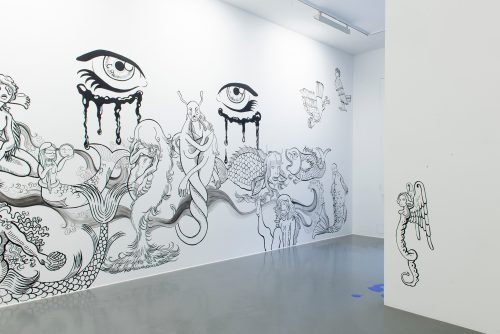
Exhibition view, Crèvecœur, 2023, Paris. Photo: Martin Argyroglo

Exhibition view, Crèvecœur, 2023, Paris. Photo: Martin Argyroglo

Polish rice, 2023, Oil on canvas, 194 × 112 cm Courtesy of the artist and Crèvecœur, Paris. Photo: Martin Argyroglo

Polish rice, 2023, Oil on canvas, 194 × 112 cm Courtesy of the artist and Crèvecœur, Paris. Photo: Aurélien Mole

Today’s Grotesque, 2023, Oil on canvas, 55 × 46 cm each Courtesy of the artist and Crèvecœur, Paris. Photo: Martin Argyroglo

Exhibition view, Crèvecœur, 2023, Paris. Photo: Martin Argyroglo

I’m so happy to see you, 2023, Oil on canvas, 112 × 145,5 cm Courtesy of the artist and Crèvecœur, Paris. Photo: Aurélien Mole

Exhibition view, Crèvecœur, 2023, Paris. Photo: Martin Argyroglo

Exhibition view, Crèvecœur, 2023, Paris. Photo: Martin Argyroglo

I’m afraid of hydrangeas, 2023, Oil on canvas, 60,6 × 50 cm Courtesy of the artist and Crèvecœur, Paris. Photo: Aurélien Mole

Exhibition view, Crèvecœur, 2023, Paris. Photo: Martin Argyroglo

Same story, 2023, Oil on canvas, 112 × 145,5 cm Courtesy of the artist and Crèvecœur, Paris. Photo: Aurélien Mole

Exhibition view, Crèvecœur, 2023, Paris. Photo: Martin Argyroglo

Exhibition view, Crèvecœur, 2023, Paris. Photo: Martin Argyroglo

Exhibition view, Crèvecœur, 2023, Paris. Photo: Martin Argyroglo

Home visitation, 2023 Acrylic on paper 28 × 38 cm. Courtesy of the artist and Crèvecœur, Paris. Photo: Martin Argyroglo

Bit hungry, 2023, Oil on canvas, 130,3 × 162 cm Courtesy of the artist and Crèvecœur, Paris. Photo: Aurélien Mole

Peeking, 2023, Oil on canvas, 45,5 × 38 cm each (diptych) Courtesy of the artist and Crèvecœur, Paris. Photo: Aurélien Mole

Exhibition view, Crèvecœur, 2023, Paris. Photo: Martin Argyroglo
Inhabited by characters with broadly, intentionally simplified traits and postures, with hyper-expressive faces that contrast with the hieratic aspect of their bodies, in scenes that are side by side, or are superimposed on the canvas with no chronology or apparent rationale, like vignettes, Kyoko Idetsu’s paintings immediately plunge the spectator into a highly original synthesis of several histories of art.
The painting is not on a surface, but on a plane which is imagined, stated Philip Guston. With Kyoko Idetsu, the composition of the painting is astonishingly free. The world is apprehended by drawing, and a large dose of spontaneity. With no use of chiaroscuro, but with lively strokes, clear lines and determined colours. A pattern often criss-crosses the background of a canvas: it’s a street, the map of a town, or tiling. The characters are often far too big for the scale of the background and this discrepancy makes them alien to their own environment.
Kyoko Idetsu does not truncate spaces and figures out of derision, but according to her interpretation, clearly linked to her own emotions when confronted by the most common situations of everyday life. She depicts episodes of silent recreation with simple rhythms and a machinal communication. Her personal pictorial science is thus an inhabited topography, tinged by both the burlesque and melancholy. There is more at stake than first seems. The point is to underline what connects people together, on a daily basis, by simple looks, gestures and words, while identifying, through ordinary epiphanies, that little part of humanity which capitalism has not yet totally recuperated. “To be cared for is the invisible substructure of autonomy, the necessary work brought about by the weakness of a human body across the span of life. Our gaze into the world is sometimes a needy one, a face that says ‘love me’, by which it means something like ‘bring me some soup’”, wrote Anne Boyer in The Undying, published in 2019.
A nurse with a rundown battery, and the possibly rather paternalistic commentary of the doctor accompanying her, a home-nurse snacking to pass the time, because they elude “uniform and banal perfections”, in the words of James Ensor. Failings, which are in principle harmless, but which can become irritations. A little malaise in civilisation? Even if Kyoko Idetsu doesn’t press the point, she suggests the context of her paintings by using a brief narrative. It is not a title, nor an allegory, it is rather an identification as in a testimony. Using a very narrow thread which is sometimes drawn towards the grotesque, and sometimes caricature, Kyoko Idetsu weaves a muted commentary on the society around her, a highly normative Japanese society, in which the sense of collective duty dominates individual rights. A society in which women obtain only the places they manage to make for themselves, with great abnegation.