Andreia Santana
"A door handle, a handshake"
Project Info
- 💙 Oakville Galleries
- 💚 Séamus Kealy
- 🖤 Andreia Santana
- 💜 Séamus Kealy
- 💛 Jimmy Limit
Share on

Andreia Santana: A Door Handle, A Handshake in Gairloch Gardens, 2025.
Advertisement


Andreia Santana: A Door Handle, A Handshake in Gairloch Gardens, 2025.

Andreia Santana: A Door Handle, A Handshake in Gairloch Gardens, 2025.

Andreia Santana: A Door Handle, A Handshake in Gairloch Gardens, 2025.

Andreia Santana: A Door Handle, A Handshake in Gairloch Gardens, 2025.

Andreia Santana: A Door Handle, A Handshake in Gairloch Gardens, 2025.

Andreia Santana: A Door Handle, A Handshake in Gairloch Gardens, 2025.

Andreia Santana: A Door Handle, A Handshake in Gairloch Gardens, 2025.

Andreia Santana: A Door Handle, A Handshake in Gairloch Gardens, 2025.
Oakville Galleries presents solo exhibitions by Andreia Santana at Gairloch Gardens.
A Door Handle, A Handshake is Andreia Santana's first solo exhibition in North America. Developed during her residency at Oakville Galleries, the exhibition features a new series of sculptures that respond directly to the gallery architecture and surrounding environment. This exhibition has been a work in progress in Oakville during the artist’s residency, and as such, the artist has drawn upon a few references—architectural, literary and sculptural—while producing her works here on site at Oakville Galleries.
Firstly, the exhibition title quotes Finnish architect Juhani Pallasmaa from his book, The Eyes of the Skin: Architecture and the Senses. In his book, Pallasmaa argues that Western architecture has become too focused on vision, leading to an impoverished, "ocularcentric" constructed environment. This western-centric vision, he argues, goes back to ancient Greek culture, where sight has been privileged over other senses. Modern architecture and its pedagogies are thus less sensory, leading to a detached, more alienated experience and diminishing our interaction and awareness altogether. Pallasmaa speaks in terms of an “imagery of persuasion” in modern architecture, which leaves aside artistic, societal, and ethical autonomy while emphasizing a techno-economic, professionalized logic. Pallasmaa advocates instead for
1
a return to multi-sensory experiences, where haptics, sound, smell, and even bodily sensation and temperature are integrated into the design and creation of architecture, fostering a deeper, more palpable connection between people and their surroundings. He emphasizes the notion of bodily experience as a central aspect for designing and being within architecture. Ultimately, Pallasmaa contends for a more humane approach to architecture as a kind of playful, suggestive manifesto for our future. We might see much of the modern urban architecture surrounding us therefore as lacking from this perspective, and in a dialectical manner, then itself being an invitation to try things differently in the future. That is, the cold and brutalistic tendencies found in modern and contemporary architecture might spur new open and humanistic approaches to future architecture.
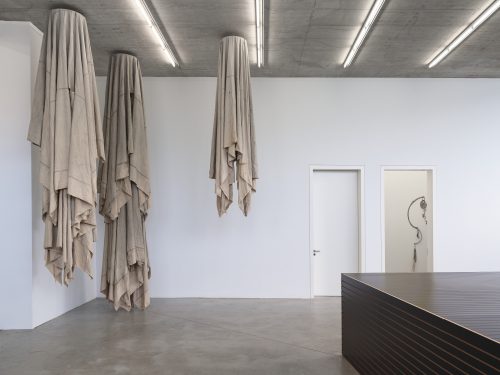
The artist has been inspired by these notions, especially in the context of this exhibition. Drawn to the architecture of the gallery here at Gairloch Gardens, the artist makes and arranges her work in the spaces, emphasizing the first tactile impressions a person has with a building. Her sculptures come off the walls as if themselves inspired by and emerging from the more humanistic elements of the architecture, or indeed its very human histories both as a domestic setting and a very active gallery for art—also emphasizing a sense of touch and tenderness especially. Just as a handshake can portray a sense of someone's character, she notes, a door handle communicates and reinforces its connection to the user, and to the architectural experience through touch, material, and design. The large windows that look out to the seasonally changing landscape of the gardens come into play with the exhibition, and are echoed in her sculptures—here even more than our usual exhibitions, as the tactility of the gardens - and not simply their appearance - are called into play. Having spent much of this past summer as well as the early parts of the autumn here, Andreia Santana
2
has immersed herself in this architecture and place, and all her work in the exhibition arises or is included in keeping with her sensitivity to the place—tactile, audible, sensory, as well as, visual. There is also a thoughtful interplay of light and shadow created from the placement of the screens and frames of the sculptures as well as the glass sculptures and small glass encasings in the screens. Within these small glass encasings, which are carefully soldered into the mesh-sculptures, one sees fossil-like shapes, suggestive of the passing of time and the temporality, vulnerability and fragility of all life.
The artist also references Canadian author Lisa Robertson’s first novel The Baudelaire Fractal in her exhibition. This 2020 book blends magical realism, literary criticism, and arcane memoir. In this complex work, a female poet wakes up one day in a hotel room having written all of Charles Baudelaire's works. The book explores intersections of identity, authorship, and notions of artistic canon, especially with a feminist rereading of literary tradition. In a gesture of curiosity and admiration, as well as a nod to Robertson’s unorthodox rereading of Baudelaire, Santana references another artist - namely, the sculptures, commissioned public art works and interventions of Canadian artist Ron Baird from the 1970s to the 1980s. Indeed, Ron Baird was commissioned to design the gates at our Centennial Gallery site, which are there to this day. These gates can be seen both outside the building as well as within, where they are adjacent to the interior and exterior gallery entrances. Throughout many of the works in this exhibition, we see curious shapes, often appearing like arcane letters or numerals, that sit within the mesh-screen sculptures. These arise out of Ron Baird’s historical works - both the doors at the Centennial Library and Gallery in downtown Oakville, as well as other sculptural works that the artist has found through researching Ron Baird’s oeuvre over the many years he has been producing.
3
With a practice focused mainly on sculpture, Andreia Santana’s works are often marked by a minimalist approach. Her sculptures convey a sense of fragility and vulnerability while expressing a poetic force. Her work also often explores notions of collective “transcorporeality” and material performativity, utilizing sculpture as a platform for interventions that incorporate movement and action. We see these approaches at work here in a site-specific set of sculptural and architectural gestures, arising from and at play with the spaces she has so carefully come to know. Consciously arranged in the gallery space, her translucent, metal-mesh sculptures integrate the interior architecture of the space and the external landscape of the garden, while also revealing near-invisible glass elements within their interiors. They invite us to ponder on themes of architecture and space, human presence as well as authorship, gender, and the relationship between language and the self.
Séamus Kealy