Nellie Lindquist
Make the World

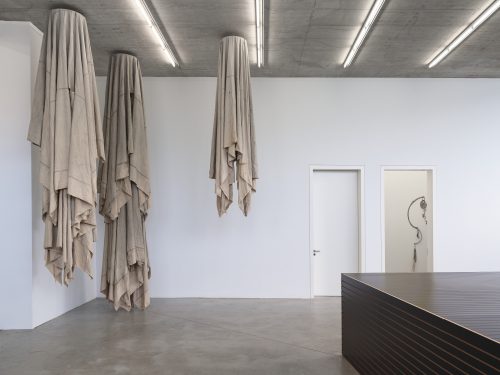
Make the World, exhibition view
Advertisement


Make the World, 2025, detail

Lullabies, 2025, Gleam and Glare, 2025


Lullabies, 2025

Gleam and Glare, 2025

Gleam and Glare, detail

Lullabies, installation view

Make the World, detail

Make the World, 2025
Anyone can break up a showing of an enemy propaganda film by putting two or three
dozen large moths in a paper bag. Take the bag to the movies with you, put it on the
floor in an empty section of the theater as you go in and leave it open. The moths will fly
out and climb into the projector beam, so that the film will be obscured by fluttering
shadows.
Simple Sabotage Field Manual, pp. 26-27
In 1944, the Office of Strategic Services, a precursor to the CIA, authored a remarkable
document: the Simple Sabotage Field Manual, a 40-page list of instructions for “simple acts
which the ordinary individual citizen-saboteur can perform.” Intended for distribution among the
population in German-occupied European countries during the late stages of World War II, this
secret document – declassified and publicly available since 2008 – offered encouragement for
covert ground-level acts of disruption that any citizen could carry out.
Nellie Lindquist takes a most peculiar detail from this list of practical instructions as the starting
point for her animated video, in which she employs a group of moths as the protagonists
fulfilling the task of sabotage as laid out in the Field Manual. Released into a dark space, the
moths flutter across the screen, making their way to the only source of light – the projection
beam, rendered into a flat shape reminiscent of the sun or the moon. In the cartoonish
animation, the projected image remains absent from our view, obstructed by the shadows of the
insects’ stroboscopically flapping wings. Intermittent flashes disrupt the dark mood of the
animation otherwise characterized by its chiaroscuro lighting: the use of dramatic contrast
between light and dark achieves a sense of volume, modelling a three-dimensional glow into the
flatness of the hand-drawn critters at work on screen.
Installed on a structure evoking classic billboards, the video’s presentation extends into the
exhibition space, where lightboxes on the walls similarly mirror advertising, or propaganda,
strategies and their material carriers. Dark silhouettes dissolve into the blueish-gray tinted
panels, illuminated by the cold glare of the LED installed behind the glass. Reminiscent of a
phone screen’s glow scrolling late at night or a deserted window display, Nellie Lindquist’s
sculptures appear as ghostly objects: like props taken from a movie set, removed from the
continuity of the filmic reality they help sustain.
Nellie Lindquist’s practice is driven by an interest in narrative fiction, not as an escape from
reality, but as an important building block in understanding how many of the structures that
shape our world are maintained by fictions. In a reality increasingly indistinguishable from
dystopian storytelling – as we witness the fascisation of world powers, a genocide, and defacto
lawlessness on the international political stage in its wake – the Simple Sabotage Field Manual
itself reads like a fiction. From a contemporary perspective on the vast technological capabilities
of intelligence agencies such as the CIA and other power players determining our world, the
Field Manual’s list of practical instructions, in contrast, evokes the innocence of childish pranks.
Indeed, it may be exactly the naive, or banal simplicity of each step listed in the document,
however questionable its source’s connotation, that makes it relevant to the current moment.
When Hannah Arendt coined the “banality of evil” – outlining how the routines of law and
bureaucracy, the countless tasks and duties performed by seemingly ordinary people, and their
unreflective and preemptive obedience, make up the innumerable “cogs in the machine” of a
totalitarian system – she equally pointed to the fact that disabling a single cog, like a single flap
of a wing, may have a decisive effect on the machine’s overall capabilities. Nellie Lindquist’s
employment of the moth-saboteurs, whose wilful participation in the act of sabotage remains a
fiction, serves as a reminder that we can all make the world, and shape its realities.
Make the World
2025
HD video projection with sound, 5’15, looped
Installed on wooden structure
Credits:
Direction, edit and animation design: Nellie Lindquist
Animator/CGI: Axel Lindquist
Sound design and score: Oliver Nehammer
Lullabies
2025
120x92,5x9 cm
Acrylic glass, UV foil, LED lights, printed foil, window film
Gleam and glare
120x92,5x9 cm
Acrylic glass, UV foil, LED lights, printed foil, window film
Exhibition text by Linnéa Bake
Make the World is supported by:
Danish Arts Foundation
Beckett Foundation
Linnéa Bake