Natascha Frioud & Gaël Epiney
Invisível
Project Info
- 💙 mala voadora
- 💚 Linda Toivio
- 🖤 Natascha Frioud & Gaël Epiney
- 💜 Linda Toivio
- 💛 Natascha Frioud & Petr Hosek
Share on

Advertisement


Exhibition presented by mala voadora (Porto) in collaboration with Hošek Contemporary (Berlin).
Despite their intended glory, there is nothing as invisible in this world as a monument, wrote Austrian philosophical author Robert Musil in the 1920s. He claimed that since monuments are built to be seen and remembered, they eventually become unnoticeable while people pass by without giving them a single thought. “They are impregnated with something that repels attention, causing the glance to roll right off, like water droplets off an oilcloth, without even pausing for a moment.” In their collaborative project Invisível, Swiss artists Natascha Frioud and Gaël Epiney question why certain sculptures are forgotten, no longer considered or looked at, and if they could somehow be reconsidered.
Invisível unfolds the second stage of the project, initiated earlier this year. It follows Unsichtbar (‘invisible’ in German), an exhibition presented in May 2025 at Hošek Contemporary gallery in Berlin. Each stage of the project is city-specific, while the concept is conceived to be transferred to any urban setting. Its local relevancy stems from extensive research within the neighbourhoods and thorough engagement with either habitual or unknown surroundings. The ten sculptures chosen for the exhibition in Porto vary from public art pieces to monuments, each blending into the landscape, growing moss or serving as impromptu bird stands. By seeking out these static structures standing in plain sight yet unseen, the artists acknowledge and give new meaning to unobvious elements. After Porto, the project will be further developed and adapted to other locations.
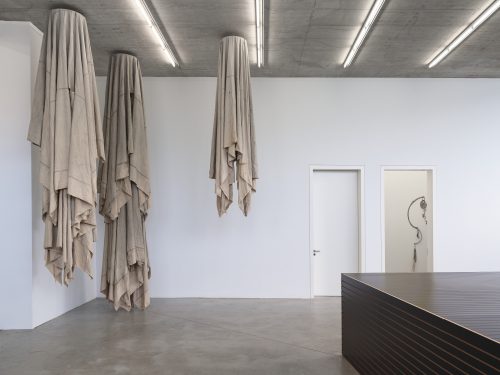
For Invisível, Frioud and Epiney start by photographing the backdrop and surroundings of selected sculptures in Porto. The photos are printed on large bath towels, then each draped on the corresponding statue. The printed towel partially conceals the statue, which camouflaged nearly optically disappears in the space, suggesting it almost never existed. In the following step of the process, the artists photograph the statues with their respective covers and these images are again printed on new towels. Together, all the prints are installed on scaffolding, illustrating the disappearance and recontextualisation of these forgotten objects. Moreover, through the act of rendering invisible, Invisível is unsettling our perception of the environment.
Choosing to print on bath towels is also significant, the spongy material serving as a filter between the sculpture and the background. The artists explain how their process transforms the nature of such a mundane and accessible item: “It’s an everyday object of no importance, that anyone can easily replace or throw away. Once printed and installed on a sculpture, the towel changes its status as an object by becoming a central element, which modifies the urban scene."
While public sculptures preserve collective memory, they also convey societal values: which monuments or sculptures do we remember, and why did they get erected in the first place? Whose memories are kept alive, whose stories are worth to be told? Both the subject matter and the sculptor reflect the politics of memory specific to an era, determining the exposure and remembrance, but also the erasure of certain events and people. The placement of a sculpture is also significant, directly disclosing how we choose to honour the subject. Maria, by sculptor José Lamas, is a recent homage to the forgotten Carquejeira women, who carried heavy bundles of gorse (‘carqueja’ in Portuguese, a plant burnt in industrial ovens or for heating) up the unimaginably steep hills of Porto. The exploitation of these women’s labour was essential for the functioning of society until the first half of 20th century, yet it took years of dedication and convincing to even obtain the permission for such a sculpture. It is located in a car park since 2020, practically tucked under a bridge, far from the crowds and glory.
Despite the dissimilarities encountered during the research and photographing phases of the project in Germany and Portugal, Frioud and Epiney frequently observed the forgotten purpose that many sculptures have in common. Although physically present, losing their intended function and meaning turns them into near non-places void of interaction, identity and experience. Invisível is mindful of the unnoticed; by deconstructing the process of becoming invisible, it restores value to these neglected silhouettes of the urbanscape.
Linda Toivio