Julia Królikowska
HOST
Project Info
- 💙 Villa of Art History Institute in Poznan, Poland
- 💚 Julia Stachura
- 🖤 Julia Królikowska
- 💜 Julia Stachura
- 💛 Marcin Sokalski
Share on

Julia Królikowska, Zanurzenie, 2025, acrylic and oil on organza, three panels. Photograph: Marcin Sokalski. Courtesy of Julia Królikowska.
Advertisement


Julia Królikowska, Zanurzenie, 2025, acrylic and oil on organza, three panels. Photograph: Marcin Sokalski. Courtesy of Julia Królikowska.

Julia Królikowska, Zanurzenie, 2025, acrylic and oil on organza, three panels. Photograph: Marcin Sokalski. Courtesy of Julia Królikowska.

Julia Królikowska, Śluzowka I, 2025, acrylic and oil on organza, 50x60 cm. Photograph: Marcin Sokalski. Courtesy of Julia Królikowska.

Julia Królikowska, HOST, exhibition view, October 1 — October 3, 2025, Villa of Art History Institute in Poznan, UAM, Wieniawskiego 3, Poznań, Poland, photo: Marcin Sokalski. Courtesy of Julia Królikowska.

Julia Królikowska, Otrzewna, 2025, acrylic and oil on organza, three panels 180x110cm. Photograph: Marcin Sokalski. Courtesy of Julia Królikowska.

Julia Królikowska, Otrzewna, 2025, acrylic and oil on organza, three panels 180x110cm. Photograph: Marcin Sokalski. Courtesy of Julia Królikowska.

Julia Królikowska, HOST, exhibition view, October 1 — October 3, 2025, Villa of Art History Institute in Poznan, UAM, Wieniawskiego 3, Poznań, Poland, photo: Marcin Sokalski. Courtesy of Julia Królikowska.

Julia Królikowska, Osierdzie (detail), 2025, painting object, organza, wool, hair, and fur. Photograph: Marcin Sokalski. Courtesy of Julia Królikowska.

Julia Królikowska, HOST, exhibition view, October 1 — October 3, 2025, Villa of Art History Institute in Poznan, UAM, Wieniawskiego 3, Poznań, Poland, photo: Marcin Sokalski. Courtesy of Julia Królikowska.

Julia Królikowska, Kosmówka, 2025, acrylic and oil on organza, 35 x 45 cm. Photograph: Marcin Sokalski. Courtesy of Julia Królikowska.

Julia Królikowska, HOST, exhibition view, October 1 — October 3, 2025, Villa of Art History Institute in Poznan, UAM, Wieniawskiego 3, Poznań, Poland, photo: Marcin Sokalski. Courtesy of Julia Królikowska.

Julia Królikowska, HOST, exhibition view, October 1 — October 3, 2025, Villa of Art History Institute in Poznan, UAM, Wieniawskiego 3, Poznań, Poland, photo: Marcin Sokalski. Courtesy of Julia Królikowska.

Julia Królikowska, Crustosum, 2025, acrylic and oil on organza, various sizes, site-specific. Photograph: Marcin Sokalski. Courtesy of Julia Królikowska.

Julia Królikowska, HOST, exhibition view, October 1 — October 3, 2025, Villa of Art History Institute in Poznan, UAM, Wieniawskiego 3, Poznań, Poland, photo: Marcin Sokalski. Courtesy of Julia Królikowska.
Julia Królikowska’s pop-up exhibition, HOST, showcases her latest paintings and folding-screen painting constructions within the historic interiors of Villa at 3 Wieniawskiego Street. This building, formerly housing the Institute of Hygiene and the Department of Microbiology, is soon set to become the new home of the Institute of Art History at Adam Mickiewicz University. Królikowska’s compositions, drawing inspiration from anatomy, botany, and the underwater realm, create fleshy, layered forms that seep through translucent chiffons and silks. When lit, her paintings seem to animate, changing and evolving as if revealing the inside of a body overgrown with coral.
Królikowska’s compositions evoke membranes, skin, muscle fibers, or fur — fleshy, haptic structures that stimulate a multisensory reception of the works. The color palette, ranging from flesh tones, through grays, to neon green, suggests the complexity of matter and its biological diversity. Her paintings do not depict a specific organism but rather a state of being-a-body, which is in constant transformation. It swells, stretches, and escapes the frame.
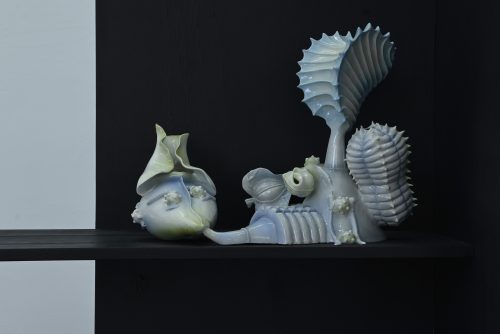
The artist also incorporates sculptural creations woven from hair, fur, and wool, forming abstract, organic, soft objects. Królikowska uses materials of human and animal origin, creating interspecies hybrids that question the boundaries of identity and introduce the idea of corporeal community. In these forms, the presence of the abject — understood through Julia Kristeva as that which is cast off and difficult to grasp fully — is strongly felt. Hair and fur, typically belonging to the exterior and serving as protective layers, in Królikowska’s works, penetrate the interior, dismantling bodily boundaries. Here, they are what disturbs and fascinates at once, what demands a gaze and simultaneously rejects it.
The historical villa is a complex, layered space where a haunting past intertwines with an ever-changing present. HOST seeks to engage in dialogue with the interior and the residual traces of laboratories and medical equipment, actively working to decolonize the space. The site-specific painting installation Crustosum, created especially for the exhibition, draws upon the penetrating gaze of scientific curiosity to speculate on what might be seen beneath the microscope. Yet this vision is disrupted by splashes of neon paint evocative of toxic blood that contaminate the image and link the act of looking to a gesture of violence and intrusion.
The title HOST alludes to a carrier, a digital server, and a site where past and speculative futures intersect. What if new organisms could develop from previous experiments? In the villa’s subdued lighting, amidst spotlights and folding screens, Królikowska’s works blend with the architecture, leading viewers through an interior alive with a new, painterly tissue.
#kubaparissubmission
HOST @sztuczny_element
Julia Królikowska @julia_krolikowska
Julia Stachura @neonli
Marcin Sokalski
#kubaparis
Julia Stachura