Chloë Saï Breil-Dupont
Joys Sleep Here

Chloé Saï Breil-Dupont – Joys sleep here, Gallery Laetitia Gorsy, 2026
Advertisement


Chloé Saï Breil-Dupont – Joys sleep here, Gallery Laetitia Gorsy, 2026

Chloé Saï Breil-Dupont – Joys sleep here, Gallery Laetitia Gorsy, 2026

Chloé Saï Breil-Dupont – Joys sleep here, Gallery Laetitia Gorsy, 2026

Chloé Saï Breil-Dupont – Joys sleep here, Gallery Laetitia Gorsy, 2026

Chloé Saï Breil-Dupont – Joys sleep here, Gallery Laetitia Gorsy, 2026

Chloé Saï Breil-Dupont – Joys sleep here, Gallery Laetitia Gorsy, 2026

Chloé Saï Breil-Dupont – Joys sleep here, Gallery Laetitia Gorsy, 2026

Chloé Saï Breil-Dupont – Joys sleep here, Gallery Laetitia Gorsy, 2026

Chloé Saï Breil-Dupont – Joys sleep here, Gallery Laetitia Gorsy, 2026

Chloé Saï Breil-Dupont – Joys sleep here, Gallery Laetitia Gorsy, 2026

Chloé Saï Breil-Dupont – Joys sleep here, Gallery Laetitia Gorsy, 2026

Chloé Saï Breil-Dupont – Joys sleep here, Gallery Laetitia Gorsy, 2026

Chloé Saï Breil-Dupont – Joys sleep here, Gallery Laetitia Gorsy, 2026

Chloé Saï Breil-Dupont – Joys sleep here, Gallery Laetitia Gorsy, 2026

Chloé Saï Breil-Dupont, 'Sometimes the sun hides better than the shadow, and you didn’t see because you closed your eyes.', 2024 - 2025, oil on canvas, 190 x 140 cm

Chloé Saï Breil-Dupont, 'A portrait of Louise', 2025, oil on canvas, 190 x 140 cm

Chloé Saï Breil-Dupont, 'This bird is a bird', 2025, oil on canvas, 120 x 100 cm

Chloé Saï Breil-Dupont, 'What you did won’t be done', 2025, oil on canvas, 120 x 100 cm

Chloé Saï Breil-Dupont, 'I see you through water', 2025, oil on canvas, 40 x 30 cm
“It is said that some plants allow themselves to die when they are uprooted from their environment and moved to a place that is not their own. But can one miss a place one has never personally known? It is said that the body does not lie, and when I am there, I also know that it straightens itself as it has never done here. That it recognizes something that cannot be translated into words and transforms it into gesture.”¹
Mélanie Cao, Je vous parle ici de ce qui n’existe pas (Podcast, 2023)
In 1939, Frida Kahlo painted a striking self-portrait: she appears doubled on the canvas. The two Fridas sit side by side on a bench, holding hands, their two anatomical hearts connected by a red thread. Las dos Fridas makes visible, both externally and internally, the double origin of the artist, European through her father, Indigenous Mexican through her mother. The linked hands, the bench, and the vein materialize the space between the two bodies, an interstitial space through which the foundations of her multiple identity circulate.
Homi K. Bhabha, postcolonial theorist, writes about in-between existences constructed from hybrid realities. Those who live the in-between at the deepest level of their bodies build bridges between cultures, habitats, languages, and physical and mental territories.
Within this “in-between,” a network of visible and invisible connections unfolds. He specifies: “These interstitial spaces provide the terrain for elaborating strategies of the self, singular or communal, that initiate new signs of identity and innovative sites of collaboration and contestation in the very act of defining the idea of society.”²
To understand and find paths of representation for what constitutes society, Chloé Saï Breil-Dupont paints her personal history as well as that of those close to her. In a constant back-and-forth between the intimate and the collective, she probes fundamental questions related to memory, bodies, friendship (and more broadly, ways of forming community), love, pain, doubt, and the wide spectrum of emotions we can experience.
In 2023, Chloé Saï Breil-Dupont left Berlin to settle in Saigon. A choice driven by the need to reconnect not only with the history of her Vietnamese grandmother, but also to situate herself within a multicultural reality (French, Catalan, Vietnamese) inhabited by questions, needs, and absences. The exhibition Joys sleep here is conceived as a collage in which images are interwoven.³
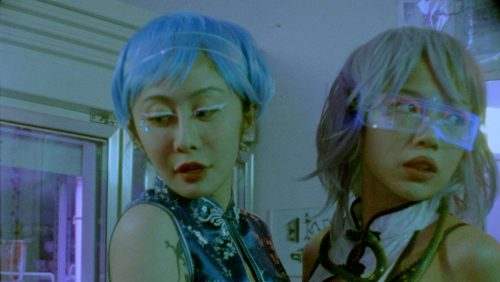
The artist constructs her paintings from images drawn from personal archives, from popular culture (notably cinema), and from images found on the internet. She works this visual material by zooming in on details, distorting them, cutting them until they become almost abstract. Within a process of refabrication and reconstruction of a visual language specific to her, Chloé Saï Breil-Dupont generates hybridizations, assemblages, and reassemblages. A working method aligned with her mixed heritage. With a smile, she explains that she is not “a cake that could be cut into quarters, into portions.” Hybridity implies the creation of a new identity and a new culture, for which she develops a singular space of representation.
In September 2025, Chloé Saï Breil-Dupont presents a solo exhibition at the Museum of Ho Chi Minh City. Ở đây, ở đó và ở khắp mọi nơi (here, there and everywhere) brings together a series of portraits of her Vietnamese and việt kiều friends. The artist explores questions of displacement, community, and the idea that “it is the bonds that create home.” In Leipzig, she chose to present two of these portraits, expanded by a new group of more abstract paintings translating complex feelings she visualizes mentally.
The artist writes: “When I look at these paintings, I often think of intimate things, extremely intimate, yet made up of external elements. To create our sentences, to express a feeling or what we see, we always speak with the words of others, those of our languages, those we have learned. And we arrange them, sometimes distort them, so that they come close to expressing something that resonates with the accuracy of our lived existences.”
Chloé Saï Breil-Dupont thus explores the rollercoasters of mental health, the wounded body, romantic rupture, love, depression, repair, secrecy, and the paths toward relearning how to live. The works make visible states, emotions, ordeals, and feelings that are difficult to verbalize and to define plastically. They reveal pivotal moments in life that constitute the thread of destiny, punctuated by encounters and events, what she calls “life-stones.”
Like the vein painted by Frida Kahlo, the color red circulates from work to work. While it symbolizes destiny, it is also central to Vietnamese culture. Red conveys joy, happiness, prosperity, and luck. It signifies celebration. Its omnipresence in the paintings, coupled with movements that are both organic and fluid, participates in a desire to represent life in all its dimensions: silent, interior, unspeakable, physical.
Through the representation of these “life-stone feelings,” the artist also examines how these stages profoundly transform her body. The paintings bear witness to mutations within her flesh. Chloé Saï Breil-Dupont thus produces a corporeal painting that completely dissolves the sterile separation between body and mind, binding intimate experience to collective experience. A visceral painting that immerses us in the fermentation of life itself.1 With thanks to Anissa Hanifa for her precious advice. The quotation is taken from the podcast Je vous parle ici de ce qui n’existe pas by Mélanie Cao, available online:https://shows.acast.com/je-vous-parle-ici-de-ce-qui-nexiste-pas/episodes/nos-corps-empoisonnes
2 Bhabha, Homi K., The Location of Culture. London: Routledge, 1994, p. 30. (Original French edition: Les Lieux de la culture: une théorie postcoloniale, Paris: Payot, 2007)
3 The three words of the exhibition title come from a love letter written to Chloé Saï Breil-Dupont. She explains:“They were the three words I truly saw in those pages full of words of love, as if they were telling me something about the situation that was completely different from what was being said in that letter. Joys sleep here: joys are sleeping here. They are not awake, but they are somewhere, and maybe you can find them.”
Julie Crenn