Kim-Camille Kreuz
One Second Longer
Project Info
- 💙 nouveaux deuxdeux
- 🖤 Kim-Camille Kreuz
- 💜 Leonie Rösler, Marlene Sichelschmidt
Share on

Advertisement


One Second Longer – to linger, to catch a fleeting perception, to seize a wandering glance: In her first solo exhibition at nouveaux deuxdeux, Kim-Camille Kreuz explores how photography, as an indexical medium, both captures and shapes the experience of seeing.
A bus, a window, a finite stretch of time – within it, an inexhaustible reservoir of possibilities. The series I can’t tell you right now follows a simple rule: the same bus route is taken daily over an extended period; each journey yields exactly one photograph. Much like the linguistic exercises of Raymond Queneau, in which a casual encounter on a bus becomes the starting point for endlessly varied retellings, Kreuz’s work shifts the relationship between constancy and variation: the unchanging framework – route, duration, initial situation – forms the basis on which difference becomes visible. Yet where as Queneau repeatedly transforms the text itself, the variation in Kreuz’s work moves into the act of seeing. Each photograph marks a decision within a narrow temporal window: the gaze selects, frames, excludes. Attention is not a given quality but a situational, rule-governed process. The materiality of the works reinforces this shift: framed and printed on glass, the originally black and white photographs undergo a subtle tonal transformation that leaves their placement within the frame unclear. In this way, I can’t tell you right now presents a precise exploration of perception under conditions of repetition and displacement.
In the series the grass is always greener on the other side, the focus moves from the variation of the gaze to the very conditions of visibility itself. Here, the photographic image serves the frame, which is no longer a neutral element but an autonomous structure. Through the layering of original frames, photographic reproductions, material traces, and unfolded packaging, the frame repeats itself. It does more than merely frame – it makes the act of framing visible. A threshold emerges that does less to separate than to stage; it points to a behind that is inaccessible, yet precisely through its inaccessibility is made present. Visibility does not appear as disclosure but as a play of revealing and concealing. Closed shutters in the photographs continue this logic: they block the view while simultaneously directing attention to what is withheld. What becomes visible is not the space beyond but the fact that it remains hidden.
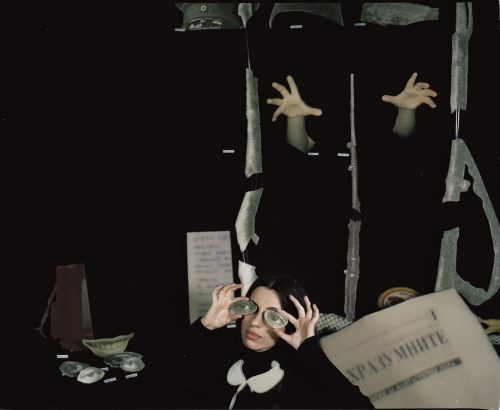
While UV printing on glass in series like I can’t tell you right now already dissolves the clear distinction between image and object, in Kreuz’s latest series the material itself takes centre stage: The best part you missed is based on a collection of glass fragments from everyday life. The photographs isolate these found objects as shards, collected over a certain period and stripping them from their original context, revealing splinters, cracks, and edges whose former function can no longer be determined. What is captured is not the event of breaking but its material aftermath. In serial arrangement, the fragments appear as individual pieces and simultaneously as part of a repeated structure. Transparencies, overlays, and fracture lines organise the picture plane and generate shaded internal forms reminiscent of studies of signs. As in I can’t tell you right now, the photographic image is printed on glass here as well, but now it establishes a direct correspondence between subject and substrate: the broken glass depicted rests upon an intact glass surface, so that the motif appears doubled, rendering material fragility visible.
Perhaps, in that single, elongated second of looking, there is less an attempt to hold on to what is seen than a discovery of the inconspicuous, and at the same time the realization that visibility always emerges in transition—and just as surely slips away again at that very point. Earlier series such as Beziehungsgeflechte and surrounded by permeable dimensions already engage with similar fields of tension between form, variation, space, and permeability. They, too, show how relationships between objects and the gaze are shifted and reflected. In the interplay of the exhibition, these many individual observations condense; seeing becomes speaking: always the same, always different, always now—and already no longer.
Leonie Rösler, Marlene Sichelschmidt