Mathias Mu
Common Ground 5th - Mathias Mu
Project Info
- 💙 Common Ground, Antwerp, BE
- 💚 Gertjan Oskar
- 🖤 Mathias Mu
- 💜 Gertjan Oskar & Mathias Mu
- 💛 Lina Van Hulle
Share on

Vessels Unhold 2025 - Mathias Mu
Advertisement



Ewers in Tender 2025 - Mathias Mu

Loot & Lore 2025 - Mathias Mu

Vessels Unhold 2025 - Mathias Mu

Common Ground - Mathias Mu

Ewers in Tender - Mathias MU

Common Ground - Mathias MU

Thulevine - Mathias Mu

Common Ground - Mathias MU

Loot & Lore 2025 - Mathias Mu

essels Unhold - Mathias MU

Ewers in Tender - Mathias Mu

A Near-Site Setting (Ungoing Series) - Mathias Mu

A Near-Site Setting (Ungoing Series) - Mathias Mu

A Near-Site Setting (Ungoing Series) - Mathias MU

A Near-Site Setting (Ungoing Series) - Mathias MU

Common Ground - Mathias Mu

Common Ground - Mathias MU

Gentle Wand - Mathias MU

Vessel in Care - Mathias MU
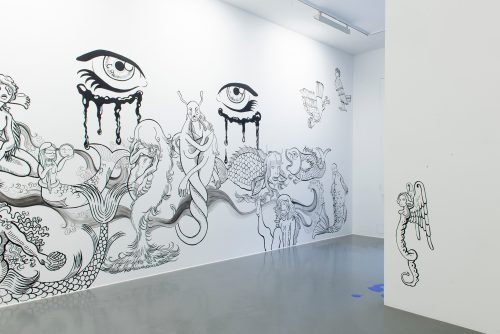
Mathias Mu presents, in a 1907 home in the South of Antwerp, a world of hybrid forms that refuse domestication. Objects intuitively tie themselves to the rooms of the house, while at the same time renouncing absolute interpretation or utility. They position themselves at an uncanny midpoint between the figurative and abstract, the ornamental and functional, the artisanal and industrial.
At first glance, you encounter objects presenting themselves as domestic: a teapot, a pitcher, a handle, a lid. Recognizable ornamental ghosts of human utility, the artifacts of the breakfast table and the tea ceremony. But at second glance the utility fades away. The handles do not invite the hand; they coil like roots, guarding the interior rather than offering it. The spouts do not pour; they droop and bulge, a thing that withdraws from its own purpose.
It asks: What is a vessel that cannot hold? Perhaps the answer lies in it's emptiness.
Just as the digital clay warps the shape of the teapot, our digital lives warp our connection to the physical world. The twisting ewer serves as a memory of a vessel, reconstructed with machines that have never tasted tea, for a human who is forgetting how to slow down.
— Mu M.
While the exhibition evokes associations with the home, as well as folkloric rituals, worlding, archaeology and animism, Mu’s work thrives in ambiguity. _Loot and Lore_ brings together an array of clues that could be mistaken for a passkey to unveil the meaning of other works: it is an inventory or backpack as often seen in video games, providing storage for an endless amount of provisions and accessories. The bag, however, mostly consists of even more bags that only scarcely reveal their contents. The fungi sporadically peeking out indicate the rhizomatic, decentralized and heterogeneous nature of Mu’s work: the objects are but points of recognition in a perpetual flow of meaning that runs beneath the surface.
In her seminal 1986 text _The Carrier Bag Theory of Fiction_, Ursula K. Le Guin suggested that it is indeed the bag, the holder, the recipient, that marks the beginning of human culture: “Before [...] the weapon, [...] long before the useful knife and ax; [...] right along with the indispensable whacker, grinder and digger, [...] with or before the tool that forces energy outward, we made the tool that brings energy home.” In line with this observation, Le Guin advocated an alternative culture of storytelling, disregarding the traditional hero who advances the plot through weapon and conflict. Instead, she proposes the carrier bag as both subject of and model for narrative practices: non-linear, fragmented and continuous stories that center relationality and collectivity. Driven by the same principles, Mu’s work aims not to resolve, but rather to hold and carry. As Le Guin’s carrier bag, it seeks not to take, but to create space, allowing for uncertainty and open ends.
Mu’s work critically examines the impact of contemporary technologies on both human consumption and creation, its true position is neither partial nor polemic. Central to this approach is a recognition of how technology has permeated domestic and private spaces, dissolving the traditional boundaries that once made the home a sacred refuge separate from the public realm. Rather than deepen this divide, Mu’s work seeks softer, more intimate expressions of technology, with digital elements almost dissolving into the final product, becoming tactile and humanized. This sensibility reflects a “carrier bag” approach of technology, emphasizing multiplicity, connection, and everyday integration over hierarchy and domination.
— Oskar G.
Gertjan Oskar & Mathias Mu